
Benefits of Potassium: Why This Mineral Matters
At a glance
Potassium is one of the most important minerals in the body, yet most people fall short of their daily needs. The benefits of potassium extend far beyond what conventional nutrition advice suggests, affecting everything from blood pressure regulation to the way muscles and nerves communicate at the cellular level.
The standard dietary guidelines tell most American adults to consume around 2,600 to 3,400 milligrams (mg) of potassium daily. But here is the problem: the recommended amount barely scratches the surface of what the body actually requires. Most Americans eat far less potassium than even these conservative targets, and the consequences show up as fatigue, muscle cramps, and elevated blood pressure.
Potassium is an essential mineral and electrolyte that every cell in the body depends on. It helps maintain fluid balance, supports nerve signaling, and plays a direct role in how muscles contract and relax. Without enough potassium, the body struggles to perform even basic functions.
What makes this mineral so overlooked is that the symptoms of too little potassium often mimic other health conditions, leading most people and even some practitioners to miss the real cause. Understanding the full range of benefits of potassium is the first step toward correcting a deficiency that affects the majority of adults.
Why is potassium important?
Potassium is not just another nutrient on a label. It is an electrolyte, meaning it carries an electrical charge that allows cells to communicate, muscles to fire, and the heart to maintain a steady rhythm. Every heartbeat depends on potassium moving in and out of cells in precise coordination with sodium.
The body does not produce potassium on its own. All the potassium circulating through the blood and sitting inside cells must come from the diet. The kidneys regulate potassium levels by filtering excess amounts into the urine, but when intake drops too low, there is no backup system to compensate.
"In my years of working with people, one of the most common patterns involves those who eat a diet high in processed foods and low in vegetables. These individuals almost always have inadequate potassium intake, and the symptoms range from subtle fatigue to serious cardiac irregularities." — Dr. Eric Berg
How potassium works in the body
Potassium operates through something called the sodium-potassium pump, a mechanism embedded in the membrane of nearly every cell. This pump moves sodium out of the cell and potassium in, creating an electrical gradient that powers nerve impulses, muscle contractions, and fluid balance.
This is not a minor biochemical detail. Without the sodium-potassium pump working properly, nerves cannot transmit signals, muscles cannot contract, and the heart cannot maintain its rhythm. The body requires far more potassium than sodium to keep this system running, yet the modern diet delivers the exact opposite ratio.
The potassium-sodium ratio
Most people consume far too much sodium and far too little potassium. The ideal ratio is roughly 4:1 potassium to sodium, but the average American diet flips this entirely. Processed foods, restaurant meals, and packaged snacks deliver excessive sodium intake while providing almost no potassium.
When the ratio tilts toward too much sodium, the body retains water, blood pressure rises, and the kidneys work overtime to excrete the excess. Correcting this imbalance by increasing potassium-rich foods and reducing processed salt can produce dramatic improvements in blood pressure and overall cardiovascular health.
Blood pressure and cardiovascular support
The relationship between potassium and blood pressure is one of the most well-documented connections in nutritional science. Potassium helps relax blood vessel walls, promotes the excretion of excess sodium through urine, and directly counteracts the mechanisms that increase blood pressure.
Conventional advice for lowering blood pressure typically focuses on reducing sodium. That is only half the equation. A study published in the European Heart Journal found that increasing potassium intake was associated with lower blood pressure, particularly in people who consumed high amounts of sodium.
High blood pressure and potassium deficiency
High blood pressure, or hypertension, affects nearly half of all American adults. What most people do not realize is that many cases of high blood pressure are directly linked to insufficient potassium rather than excess sodium alone. The focus on salt restriction has been so dominant that the equally important role of potassium has been largely ignored.
After helping thousands of people with this issue, the pattern is remarkably consistent: those who increase their potassium intake through whole foods often see meaningful reductions in blood pressure, sometimes enough to reduce or eliminate the need for medications.
Muscle and nerve function
Potassium is essential for every muscle in the body, including the heart. Muscles contract when potassium and sodium exchange across cell membranes. When potassium levels drop, this exchange becomes unreliable, leading to weakness, cramps, and in severe cases, paralysis.
Nerves rely on potassium to generate electrical impulses. These impulses control everything from voluntary movements to involuntary processes like digestion and heartbeat regulation. Symptoms of too little potassium in the nervous system include tingling, numbness, and abnormal reflexes.
Muscle cramps and potassium
Muscle cramps, particularly in the legs and feet, are one of the earliest and most recognizable symptoms of low potassium. The cramps occur because the muscles cannot properly relax after contracting. From my experience coaching people through keto, those who add potassium-rich foods like avocados and leafy greens to their eating plan often see cramps resolve within days.
How much potassium do adults need?
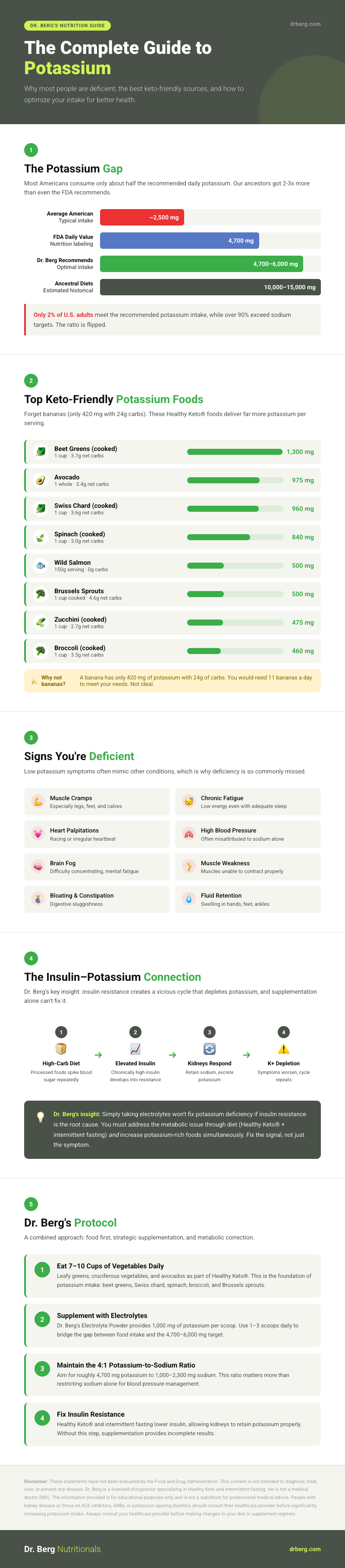
The National Institutes of Health (NIH) recommends that adult men consume 3,400 mg of potassium daily and adult women consume 2,600 mg. These figures represent the Adequate Intake (AI) level, not an optimal amount. In reality, most Americans eat only about 2,300 to 2,600 mg per day, falling well short of even these conservative recommendations.
But here is the real question: are these targets even high enough? Ancestral diets provided an estimated 10,000 to 15,000 mg of potassium daily from plant and animal foods. Modern dietary approaches, particularly those focused on whole, nutrient-dense foods, naturally deliver far more potassium than the standard American diet.
Signs of too little potassium
Low potassium, or hypokalemia, produces a wide range of symptoms. Mild deficiency causes fatigue, weakness, and muscle cramps. As levels drop further, symptoms escalate to constipation, heart palpitations, and abnormal heart rhythms. In severe cases, hypokalemia can be life-threatening.
Best food sources of potassium
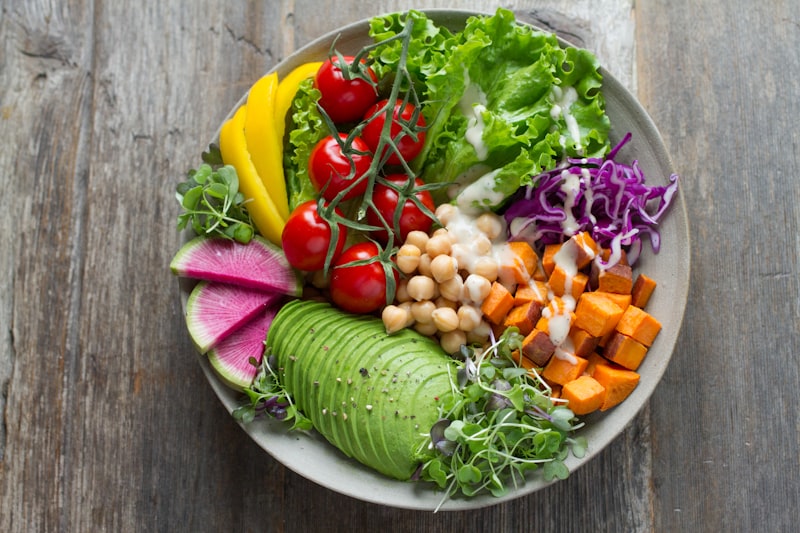
The best way to increase potassium intake is through whole, nutrient-dense foods. While many people associate potassium with bananas, several other foods deliver far more potassium per serving.
Keto-friendly potassium sources
For those following a Healthy Keto® eating plan, there are excellent food sources of potassium that align perfectly with a low-carb approach. Avocados are among the richest sources, delivering roughly 975 mg of potassium per avocado. Spinach, Swiss chard, and other leafy greens are also potassium-dense while remaining very low in carbohydrates.
Vegetables and leafy greens
Leafy greens are some of the most potassium-dense foods available. One cup of cooked spinach provides around 840 mg. Swiss chard delivers approximately 960 mg per cooked cup. Beet greens, which are often discarded, contain over 1,300 mg per cooked cup, making them one of the single best sources of the mineral.
"The real issue with potassium is that people are not eating enough vegetables. If you are consuming seven to ten cups of salad and vegetables a day on Healthy Keto, you will not have a potassium deficiency. The problem is most people are eating virtually no vegetables at all." — Dr. Eric Berg

Potassium, insulin, and metabolic health
Here is a connection that most conventional nutrition advice completely overlooks: potassium and insulin are deeply linked. Insulin drives potassium into cells, and when insulin levels are chronically elevated (as they are in insulin resistance and type 2 diabetes), potassium metabolism is disrupted.
When someone begins intermittent fasting or transitions to a Healthy Keto diet, insulin levels drop. As insulin decreases, the kidneys begin excreting more potassium and other electrolytes. This is why many people experience fatigue, cramps, and brain fog during the initial adaptation period. It is not a flaw in the diet; it is a signal that electrolyte intake, particularly potassium, needs to increase.
What I have seen over and over is that people who supplement with potassium and increase their vegetable intake during the transition to a low-carb or fasting protocol report significantly smoother adaptation. The connection between potassium, insulin, and metabolic health is one of the most underappreciated aspects of nutritional science.
Key Takeaways
- Potassium supports blood pressure regulation, muscle function, nerve signaling, and kidney health, making it one of the most important minerals in the diet.
- Most American adults do not consume enough potassium, and the symptoms of deficiency (fatigue, cramps, elevated blood pressure) are frequently misdiagnosed.
- The best food sources include leafy greens like spinach and Swiss chard, avocados, wild-caught salmon, and mushrooms, all compatible with a Healthy Keto® eating plan.
- The potassium-to-sodium ratio (4:1) matters more than absolute sodium restriction for blood pressure control.
- Potassium and insulin are directly connected; transitioning to keto or intermittent fasting increases the body's need for potassium and other electrolytes.
- People with kidney disease or those taking medications like diuretics or ARBs should consult a healthcare provider before significantly increasing potassium intake.
FAQ
1. What are the main benefits of potassium?
The main benefits include supporting healthy blood pressure, proper muscle contraction, nerve function, and fluid balance. Potassium also helps the kidneys filter waste and supports heart rhythm stability.
2. How much potassium should adults consume daily?
The NIH recommends 2,600 mg/day for women and 3,400 mg/day for men. Dr. Berg recommends 4,700-6,000 mg/day, especially for those on keto or intermittent fasting, due to increased electrolyte excretion.
3. Can too much potassium be harmful?
Yes. Too much potassium (hyperkalemia) can cause nausea, weakness, and dangerous irregular heartbeat. This is primarily a concern for people with kidney disease or those taking medications that cause the body to retain potassium.
4. What foods are highest in potassium?
Beet greens (1,300 mg/cup cooked), Swiss chard (960 mg), avocado (975 mg/whole), and spinach (840 mg/cup cooked) are among the highest sources. These are all keto-friendly, unlike bananas which only provide 420 mg with significantly more sugar.
5. Why does Dr. Berg recommend more potassium than the FDA guidelines?
Dr. Berg points to ancestral diets that provided 10,000-15,000 mg daily, the increased electrolyte excretion on keto/fasting protocols, and the role of insulin resistance in depleting potassium. He views 4,700 mg as a minimum, not a target.
Sources
- Carey RM. (2022). Treatment of Hypertension: A Review. JAMA, 328(18), 1849-1861. https://doi.org/10.1001/jama.2022.19590
- Tu W. (2024). Cardiovascular Benefits of Potassium-Enriched Salt Substitution. Hypertension, 81(5), 1041-1043. https://doi.org/10.1161/HYPERTENSIONAHA.124.22822
- Palmer BF. (2016). Achieving the Benefits of a High-Potassium, Paleolithic Diet. Mayo Clinic Proceedings, 91(4), 496-508. https://doi.org/10.1016/j.mayocp.2016.01.012
- van Dronkelaar C, et al. (2018). Minerals and Sarcopenia. JAMDA, 19(1), 6-11.e3. https://doi.org/10.1016/j.jamda.2017.05.026